Books for designing (playing) better
By: Cecilia Rodriguez
Last weekend, I went on a guided experience at a museum. Before we started, the guide asked us a question: What is your relationship with creativity? Many people immediately responded that they had no relationship with it, as they considered themselves mostly analytical and methodical people.
We begin the experience by observing a painting, placing some stools in front of it, and then proceeding with 3 tasks: Seeing (look at the drawing at the same time as we trace a single line without looking at the piece of paper), reflecting -stool change- (questioning and deciphering the author's decisions and emotions) and Connecting Translate the assumed meanings to our professional experience.
The exercise surprised everyone, and the reflection lasted for 40 minutes, ending with a brainstorming session for possible names for the work.
For me, as a designer, the success of an exercise translates into play and experimentation, essential factors for positively influencing any ideation process. Play creates an atmosphere that fosters creative behavior while supporting idea generation. It’s about reducing tensions and enjoying the design process more, whether it’s a brand, a product, or a service.
Taking advantage of Book Day and this reflection, I share some recommendations for to design play better
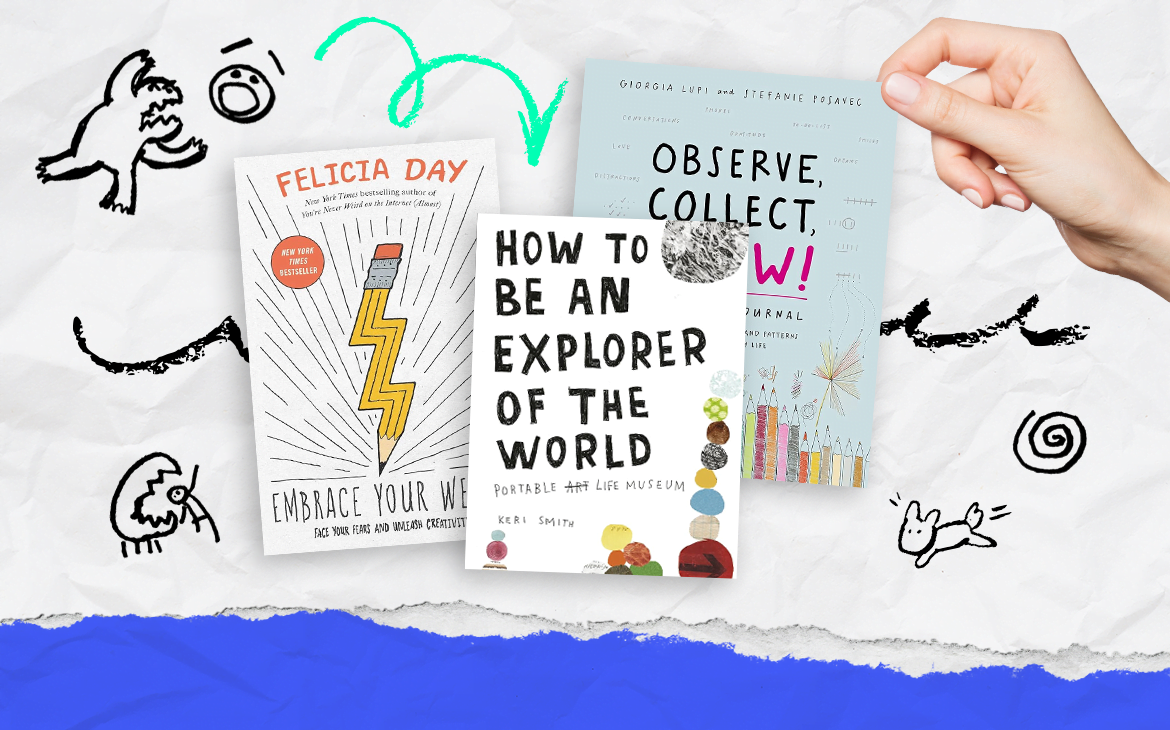
• Observe, Collect, Draw: A Visual Journal by Giorgia Lupi
This visual journal compels you to pause, observe, and document the world around you. For curious minds, it teaches you to gather moments from your life into data and drawings. It's a way to remember the beauty that exists in the ordinary.
• Embrace Your Weird: Face Your Fears and Unleash Creativity by Felicia Day
This book feels like a pep talk from a friend who knows exactly how it feels to be different. It's a reminder to embrace and celebrate your weirdness because that's where your creativity lies.
• How to Be an Explorer of the World by Keri Smith
This book is a guide to seeing the world with fresh eyes. It teaches you that curiosity is key to creativity and that there are infinite wonders to discover in your everyday surroundings. It encourages you to be an explorer in your own life, to ask questions, and to never stop learning.
BONUS
Steal Like an Artist by Austin Kleon
Although the game in this book is not literal, we can infer it from some of its chapters such as remixing o influence map. The author redefines creativity as a process of taking, transforming, and combining ideas to create something new through a playful approach. They teach you that it's not about starting from scratch, but about building on what has come before.