The Hidden Cost of Ignoring Churn
In retention analysis, metrics usually tell us how many customers leave, but rarely explain why Why real. Many organizations operate under the false premise that churn is a price decision that can be solved with transactional incentives. However, from our research lab: Deciphering, we have observed that churn is the final stage of a disconnection process that begins long before the cancellation request.
As experts in understanding people's relationships with brands, we know that loyalty isn't a points program; it's a relationship system that must be designed to be sustainable over time.
The gap between data and behavior
The most common error in strategies Customer Retention is to ignore the user's context. A dashboard might show a drop in usage frequency, but only the User Research can you reveal if that drop is due to a failure in the Service Blueprint or a change in the person's habits.
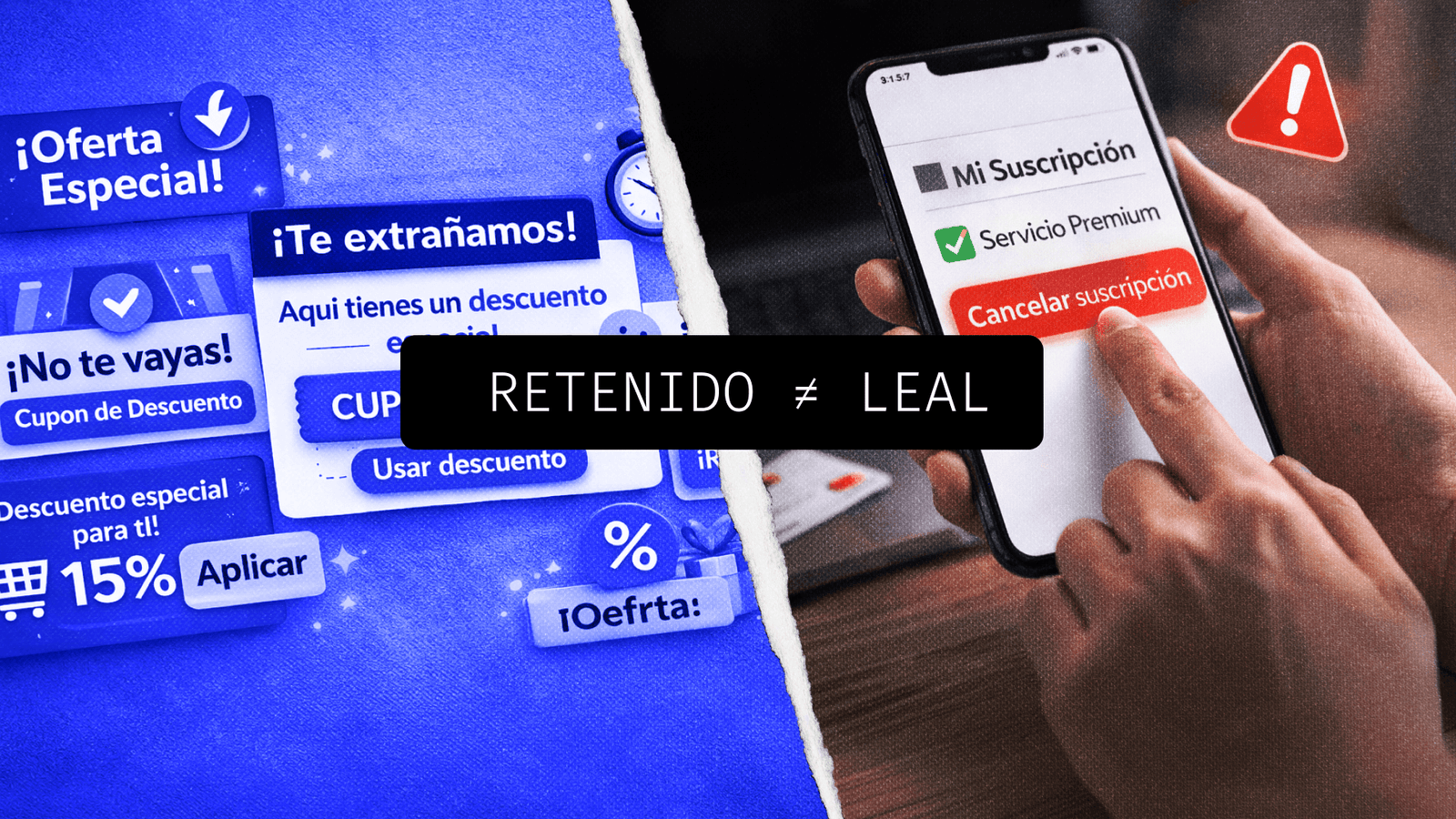
Recently, in the Global CX Forum 2026, the risk of «obstructive AI» was discussed. Implementing bots that make it difficult for customers to leave is not retention; it's increasing the cognitive friction. In Gerundio, we promote the Human AutomationUse technology to identify early signs of frustration and activate interventions that resolve the root problem before the user seeks an alternative.
We call silent abandonment the period during which a user stops perceiving value in a service but keeps their subscription active. Identifying this pattern through Research It is the only way to prevent churn in online stores.
From diagnosis to decision
Our methodology in Deciphering allows us to transform field findings into strategic criteria that impact the business:
- Archetypes Behavioral vs. Demographic Segmentation: Effective retention doesn't treat everyone the same; design solutions based on how people actually use the product.
- Friction point mapping: We identified the cracks in the experience that generate operational fatigue. If the service is difficult to use, no discount coupon will regain lost trust.
- Post-Sale Concept Validation Loyalty is built by ensuring the brand promise translates into real and sustained adoption of new habits.
5 principles of research to reduce churn
- Listen to the silence: Lack of complaints doesn't mean loyalty. The customer who stops interacting is sending the loudest warning sign.
- Cognitive friction is when your service requires excessive mental effort to deliver a simple benefit; churn is inevitable.
- Dignify the Farewell: Research tells us that a smooth cancellation process preserves the possibility of a future Loyalty Loop.
- Solve the problem, not the symptom: If research detects a product flaw, investment should go towards interface (UI) or process (CX) design, not marketing.
- Understand the context, not just the channel: Channel Orchestration only works if the message is relevant to the user's current life stage.
Reducing churn is the result of a commitment to operational excellence and empathy. Brands that transcend are those that stop seeing the customer as a retention figure and start seeing them as a relationship that requires constant maintenance.
In Gerundio, we use the tools of Deciphering to help organizations make better decisions, ensuring every strategy translates into a real and sustainable connection with people.